
Part 3 — Securing Data: Applying Zero Trust Principles Across Azure/GCP
- Mar 15
- 4 min read
Securing Data with the Three Core Elements
Data is the ultimate asset. Zero Trust ensures it stays protected everywhere it travels.
Closed‑loop control system: Know → Protect → Monitor.
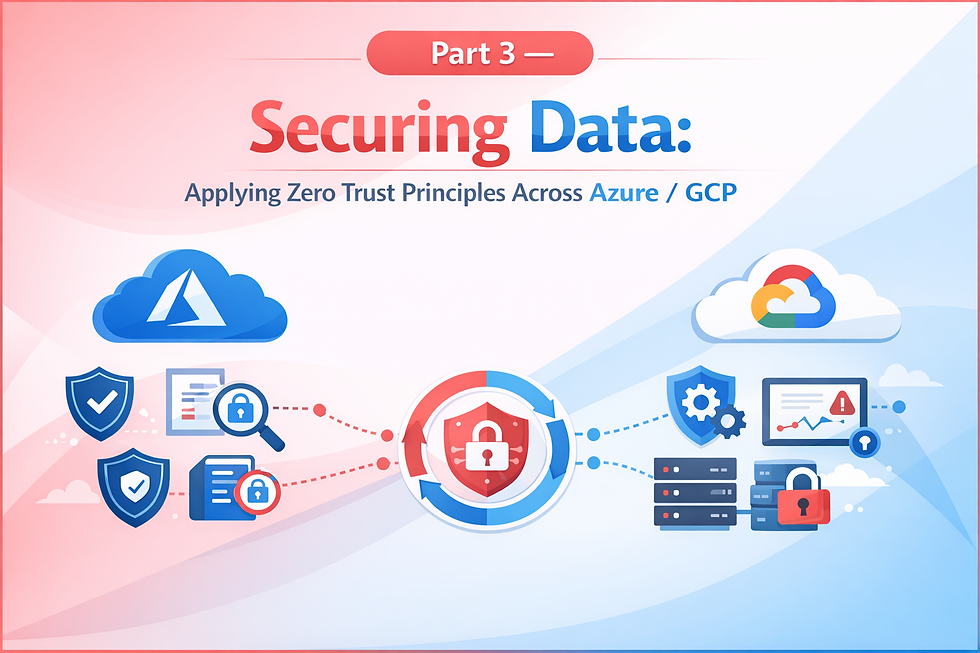
Know Your Data
Zero Trust begins with visibility.You cannot enforce least privilege or prevent exfiltration unless you know:
What data you have (PII, PCI, PHI, IP, financials, contracts)
Where it lives (on‑prem, cloud, SaaS, endpoints)
Who has access and whether that access is justified
How sensitive it is, using automated classification and labeling
Outcome: Every file, message, and dataset carries a sensitivity label and becomes governable.
Protect Your Data & Prevent Loss
Once data is classified, Zero Trust enforces policy‑driven protection:
Labeling + encryption applied automatically
Conditional Access enforcing identity, device, and session risk
DLP policies blocking oversharing, risky downloads, and external exposure
App governance to control SaaS data flows
Confidential computing to protect data in use
Outcome: Only authorized users, on compliant devices, under verified conditions, can access or share sensitive data — even outside the corporate boundary.
3. Monitor & Remediate Continuously
Zero Trust assumes breach, so continuous monitoring is non‑negotiable:
Detect anomalous downloads, mass copy, or exfiltration attempts
Identify insider risks and risky user behavior
Trigger automated remediation (block, revoke, quarantine, alert)
Feed signals into SIEM/SOAR for orchestrated response
Continuously refine policies based on real‑world behavior
Outcome: Data misuse is caught early, and controls adapt dynamically.
Core Elements | Zero Trust Alignment |
Know your data | Visibility, classification, identity‑aligned access |
Protect your data | Least privilege, encryption, DLP, policy enforcement |
Monitor & remediate | Assume breach, continuous evaluation, automated response |
Data Zero Trust deployment Objectives
An information protection strategy needs to encompass your organization's entire digital content. As a baseline, you need to define labels, discover sensitive data, and monitor the use of labels and actions across your environment. Use of sensitivity labels is discussed at the end of this guide.
Core Element | Deployment Objectives | Descriptions |
Know your data | Initial Objective: Data is automatically classified and labeled. Additional Objective : Classification is augmented by smart machine learning models. | Discover, classify, and label sensitive data across cloud, SaaS, and on‑prem. Establish visibility into data types, locations, and sensitivity levels. |
Protect Your Data & Prevent Loss | Initial Objective I: Access decisions are governed by encryption.Additional Objective IV: Access decisions are governed by a cloud security policy engine.Additional Objective V: Prevent data leakage through DLP policies based on sensitivity labels + content inspection. | Apply policy‑driven protection, encryption, and access controls. Prevent oversharing, unauthorized access, and data exfiltration. |
Monitor & Remediate Continuously | Supports All Objectives: Continuous monitoring ensures encryption, classification, policy enforcement, and DLP remain effective. | Detect risky behavior, anomalous access, and exfiltration attempts. Automate remediation and refine policies based on real‑world signals. |
Zero Trust Deployment Objectives — Azure vs. GCP Service Mapping
Deployment Objectives | Azure Services | GCP Services | What This Objective Achieves |
I. Access decisions are governed by encryption | Azure Key Vault (CMK/HSM) Azure Storage Encryption Azure SQL TDE Azure Confidential Computing Entra ID Conditional Access | Cloud KMS (Customer‑managed keys) Cloud HSM Default Encryption at Rest Confidential VMs / Confidential Space IAM Conditions | Ensures all access decisions rely on encryption + identity context. Data is unreadable without proper keys and verified identity. |
Data is automatically classified and labeled | Microsoft Purview Information Protection (Auto‑labeling)Purview Data Map & Catalog Azure SQL Data Classification | DLP API (Content classification) Cloud Data Loss Prevention (Sensitive data detection) Dataplex Data Catalog | Automatically identifies sensitive data (PII, PCI, PHI) and applies labels for governance, protection, and DLP.Classification is augmented by smart ML models |
Classification is augmented by smart ML models | Purview Auto‑Labeling with ML Defender for Cloud ML‑based anomaly detection | Cloud DLP ML‑based classifiers Vertex AI custom classifiers Security Command Center ML insights | Uses machine learning to detect sensitive data patterns, anomalies, and advanced data types beyond simple regex rules. |
Access decisions are governed by a cloud security policy engine | Entra ID Conditional Access Microsoft Purview Policies Defender for Cloud Apps Azure Policy | IAM Conditions- Organization Policy Service BeyondCorp Enterprise (Zero Trust access engine) Cloud Armor (Context‑aware access) | Centralizes access decisions using identity, device posture, risk, network, and session context. |
Prevent data leakage through DLP policies based on sensitivity labels + content inspection | Purview DLP (Email, Teams, SharePoint, OneDrive, Endpoint)- Defender for Cloud Apps (Session controls)- MIP Sensitivity Labels | Cloud DLP (Content inspection + redaction)- VPC Service Controls (Data exfiltration boundaries)- BeyondCorp Enterprise DLP | Prevents oversharing, risky downloads, unauthorized transfers, and exfiltration using label‑aware and content‑aware controls. |
Core Implementation Matrix (Azure/GCP)
Security Pillar | Azure Implementation | GCP Implementation | Zero Trust Value |
Conditional Access | Microsoft Entra ID (Conditional Access): Uses signals like "User Risk" and "Device State" to gate every login. | Access Context Manager: Defines granular policies based on IP, device metadata, and user identity. | Verify Explicitly: Ensures access is granted only under specific, pre-verified conditions. |
Privileged Access | Privileged Identity Management (PIM): Offers "Just-In-Time" (JIT) elevation for admin roles. | IAM Conditions & IAM Deny: Allows time-bound or resource-bound access via CEL (Common Expression Language). | Least Privilege: Minimizes the window of opportunity for an attacker if a credential is stolen. |
Network Micro-segmentation | Network Security Groups (NSGs) & Private Link: Restricts traffic flow to specific private IP ranges. | VPC Service Controls: Creates a "service perimeter" that prevents data movement between services even with valid keys. | Limit Blast Radius: Prevents lateral movement across the cloud environment. |
Data Discovery | Microsoft Purview: Automatically scans and labels sensitive data across the Azure estate. | Sensitive Data Protection (DLP): High-speed scanning and de-identification of PII across BigQuery and Buckets. | Data-Centric Security: Prioritizes protection based on the sensitivity of the actual data payload. |
Hardware Security | Azure Confidential Computing: Uses Intel SGX and AMD SEV to protect data in use. | Confidential VMs/GKE: Leverages hardware-level encryption for data residing in memory (RAM). | Assume Breach: Protects data even if the underlying hypervisor or OS is compromised. |
Conclusion
Zero Trust isn’t a single tool—it’s a disciplined, data‑first strategy built on continuous verification, intelligent classification, and adaptive policy enforcement. By aligning each deployment objective with native Azure and GCP services, organizations gain a clear roadmap to protect sensitive data across multi‑cloud environments. Azure’s Purview, Entra ID, and Defender suite combine with GCP’s Cloud DLP, IAM Conditions, and BeyondCorp to deliver strong encryption‑based access, automated classification, and label‑aware DLP. When implemented together, these controls create a resilient, scalable, and future‑ready security posture that enables the business to innovate with confidence.
Comments