
Designing Azure Cloud Solutions with Security Best Practices Part 1
- Feb 15
- 3 min read
In today's evolving threat landscape, the traditional "castle-and-moat" security model is no longer sufficient. As we move workloads to the cloud, identity becomes the new perimeter. This series explores how to architect Azure solutions using the Zero Trust framework: a security model that assumes breach and verifies every request as though it originated from an open network.
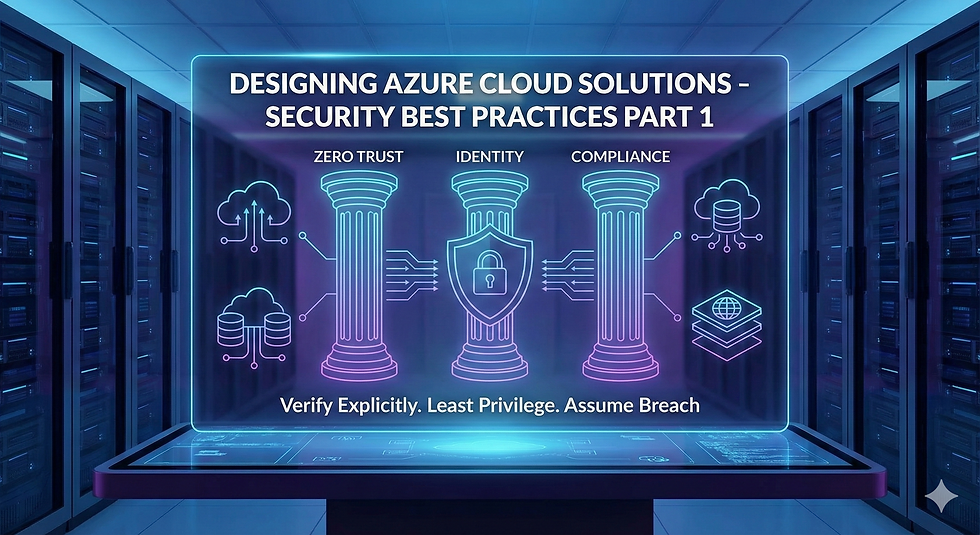
Zero Trust Framework at a Glance
The Zero Trust framework is built on the reality that "perimeter-based" security is obsolete. Instead of assuming everything behind a corporate firewall is safe, Zero Trust mandates that every access request be fully authenticated, authorized, and encrypted before granting access.
It functions as a holistic strategy that integrates several key pillars:
Unified Policy Engine: Acting as the "brain," this engine evaluates real-time signals (user risk, device compliance, location) to make instant access decisions.
Continuous Monitoring: Security is not a one-time check at login; it is an ongoing process of monitoring telemetry to detect and respond to threats in real-time.
End-to-End Encryption: Data is protected both at rest and in transit, ensuring that even if a network segment is intercepted, the information remains unreadable.
Policy-Based Access: Access is granted based on specific policies rather than broad network permissions, significantly reducing the attack surface.
The Pillars of Zero Trust in Azure
Zero Trust is not a single product but a strategy centered on the principle of "Never Trust, Always Verify." It shifts the focus from a flat network to a policy-driven environment where every access request is strongly authenticated, authorized within policy constraints, and inspected for anomalies.
Our design architecture adheres to the three core principles:
Verify Explicitly: Always authenticate and authorize based on all available data points—user identity, location, device health, service or workload, data classification, and anomalies.
Use Least Privileged Access: Limit user access with Just-In-Time and Just-Enough-Access (JIT/JEA), risk-based adaptive policies, and data protection.
Assume Breach: Minimize blast radius and segment access. Verify end-to-end encryption and use analytics to get visibility, drive threat detection, and improve defenses.
Key Components of the Zero Trust Architecture
To build a resilient Azure environment, we must secure several interconnected functional areas:
Identities: Whether they represent people, services, or IoT devices, identities must be verified with strong authentication (MFA) and governed by conditional access policies.
Endpoints: Once an identity is granted access, data can flow to diverse devices—from IoT sensors to BYOD smartphones. Monitoring these endpoints for health and compliance is critical.
Applications: Applications provide the interface for data consumption. We must ensure they have appropriate permissions, are protected against exploits, and provide visibility into user actions.
Infrastructure: Whether it's virtual machines, containers, or serverless functions, infrastructure represents a primary threat vector. We use telemetry to detect attacks and automatically block or flag suspicious activity.
Tiered Identity & Access Management (IAM)
A robust Azure security strategy begins with a structured identity model. By categorizing roles into tiers, we ensure that the most sensitive "keys to the kingdom" are isolated from day-to-day operational risks.
Tier 0: The Control Plane
This is the highest level of privilege. Compromise here means compromise of the entire tenant. These roles should be strictly monitored and require Phishing-resistant MFA.
Key Roles: Global Administrator, Privileged Role Administrator, Hybrid Identity Administrator.
Best Practice: Minimize the number of permanent Tier 0 owners. Use Microsoft Entra Privileged Identity Management (PIM) for eligible assignments.
Tier 1: The Management Plane
These roles manage security policies, conditional access, and enterprise-wide applications.
Key Roles: Security Administrator, Conditional Access Administrator, Intune Administrator.
Focus: Bridging the gap between identity and device management to ensure only healthy devices access sensitive data.
Tier 2 & 3: The Workload Plane
This level encompasses specialized roles for specific services or business functions.
Key Roles: Billing Administrator, SharePoint Administrator, Exchange Administrator.
Focus: Scoped access to specific resources to prevent lateral movement.
Key Takeaways for Part 1
Identity is the Foundation: Secure the identity, and you secure the perimeter.
Tiering is Mandatory: Separate administrative concerns to limit the "Blast Radius."
Automate & Standardize: Use clear naming conventions and PIM to reduce human error.
What's Next? In PART 2/3/4, we will dive into Secure Data with Zero Trust, Zero Trust Helps you Application and Data Protected, Secure Endpoints with Zero Trust, Endpoints Zero Trust Deployment Objectives, Secure infrastructure with Zero Trust, Infrastructure Zero Trust deployment objectives

Comments